This is the final entry in the Open Assistant Diary series — an overview on everything we built and learned across six blog posts of autonomous content operations. What started as an experiment in wiring up integrations ended as a fully self-sustaining multi-agent publishing engine. Before diving into the recap, here are the six diary entries that got us here:
- Diary #1: Setting Up an AI to Market Itself — Laying the integration foundations: Nextcloud, Notion, Slack, and the principle of least privilege.
- Diary #2: Less Agents, More Control — Consolidating agent architecture and adopting the small backstory principle for leaner, more reliable prompts.
- Diary #3: Giving the Assistant a Memory for Action — Building a single-table Notion backlog as shared operational memory between human and AI.
- Diary #4: From Prompt Creep to Streamlined Agents — Taming prompt bloat with a four-tier multi-agent hierarchy and strict tool boundaries.
- Diary #5: Plugins and Social Post Automation — Dynamic plugin creation, the Plugin Creator Agent, and a multi-platform content amplification loop.
- Diary #6: Setting Up Automations — Scheduling autonomous cron flows: SEO audits, blog draft engines, and social amplification pipelines.
This recap ties those six threads together — summarising our lessons learned, extracting the engineering insights, and looking ahead at where agentic automation goes next.
1. The Scale of Autonomous Content Operations
In software engineering, the ultimate validation of an architecture is its performance under real-world workloads. Over the course of six diary entries, we subjected Open Assistant to a rigorous, self-referential stress test: configuring the AI system to autonomously manage, write, edit, and distribute its own technical development diary.
The results challenged conventional assumptions about human-to-AI leverage ratios:
- Human Effort: Under 8 hours of total human involvement across the entire six-part series. This effort was restricted solely to dictating raw, unstructured voice notes during walks or coffee breaks, and executing final one-click approvals.
- Production Velocity: At peak efficiency, the system autonomously compiled, structured, fact-checked, and published three highly technical blog posts in a single day.
- Operational Scope: The pipeline converted raw audio files and video transcripts into structured markdown, cross-referenced development logs, updated a central Notion database, ran automated SEO audits, generated promotional social media copy, and queued distribution across multiple channels.
This was not a simple linear script or a series of fragile, hardcoded connections. It was a dynamic, multi-agent cognitive architecture operating entirely above-the-line — proving that with the right structural boundaries, an AI system can reliably run its own content operations.
2. From Raw Files to Autonomous Engine
The architecture did not emerge fully formed. It evolved through a structured, feedback-driven engineering cycle. Each diary entry solved a specific systemic bottleneck, building directly on the foundations of the last.
Diary #1 (Foundations) → Diary #2 (Consolidation) → Diary #3 (Shared Memory) → Diary #4 (Agent Hierarchy) → Diary #5 (Custom Plugins) → Diary #6 (Cron Autonomy)
Diary #1: Integration Foundations and the Principle of Least Privilege
Every autonomous system requires hands and eyes in the physical world. The journey began by establishing secure, reliable integration pathways between the assistant and the core operational stack: Nextcloud for raw file hosting, Notion for database tracking, and Slack for human-in-the-loop communication.
A critical architectural decision made here was the strict application of the principle of least privilege. Rather than granting the assistant broad, administrative API tokens, we configured highly scoped, read-write permissions restricted to specific folders and database views. The Blog Master agent could create and update drafts — but it could not publish or delete. The Notion Agent could query and update records — but it could not destroy them. Every destructive action remained gated behind explicit human authorization.
This ensured that even in the event of an unexpected agentic loop, the system's blast radius was mathematically constrained.
Diary #2: Agent Architecture Refinement and the Small Backstory Principle
Initial trials utilized a highly fragmented, four-agent configuration. This introduced excessive handoff latency and context degradation as information was passed down the chain. In Diary #2, we consolidated the architecture into three highly optimized agents — merging the Browser Agent and File Handler Agent into the Research Agent, keeping the Content Writer and Blog Master focused. Less is more, right?
We also pivoted our editorial direction. Instead of chasing transient, highly stylized AI marketing copy, we configured the system to write with a timeless, objective, and factual tone. To support this, we implemented the small backstory principle: instead of loading agent system prompts with paragraphs of fictional persona fluff, we restricted instructions to precise operational constraints, behavioral boundaries, and output formatting rules. This saved valuable context window space and dramatically reduced hallucination rates.
A subtle but important coupling was also identified: agent architecture changes cascade into automation reliability. Any reorganization must be followed by a review of active cron jobs to verify their tool references still resolve correctly.
Diary #3: Building a Shared Operational Memory

A common failure mode of LLM applications is state-blindness — ideas surface faster than they can be executed, and without a persistent, structured tracking system, they vanish the moment a session is cleared. To solve this, we built a single-table Notion Backlog to act as the shared operational memory of the assistant.
One database, named Notes, houses all operational artifacts: backlog tasks, scripts, voice note transcriptions, and PDF extractions. Three simple metadata fields — Title, Type, and State — categorize and route everything. The assistant interacts with one flat table via API calls; the human operator views the same data through filtered Kanban boards, sorted lists, and chronological archives. One table, one API target, multiple clean interfaces.
By encoding explicit operational semantics into the system prompt — "add to backlog" triggers a record with State: TODO, "what's pending?" queries for State: IN PROGRESS — the assistant learned to translate conversational intent into structured database transactions. The true validation came with self-referential execution: the assistant was asked to write a script explaining its own backlog system, and it successfully queried its own database, analyzed its own configuration, and documented its own operational structure. The backlog acts as a mirror, allowing the assistant to see its place within the collaborative workflow.
Diary #4: Taming Prompt Creep with Multi-Agent Hierarchies
As the assistant's capabilities grew, we encountered prompt creep — the gradual degradation of agent performance caused by stuffing too many instructions into a single prompt. Every formatting error was patched with a new corrective clause. Every database quirk was documented in the global prompt. Over time, the system became bloated, slow, and prone to tool-selection misfires.
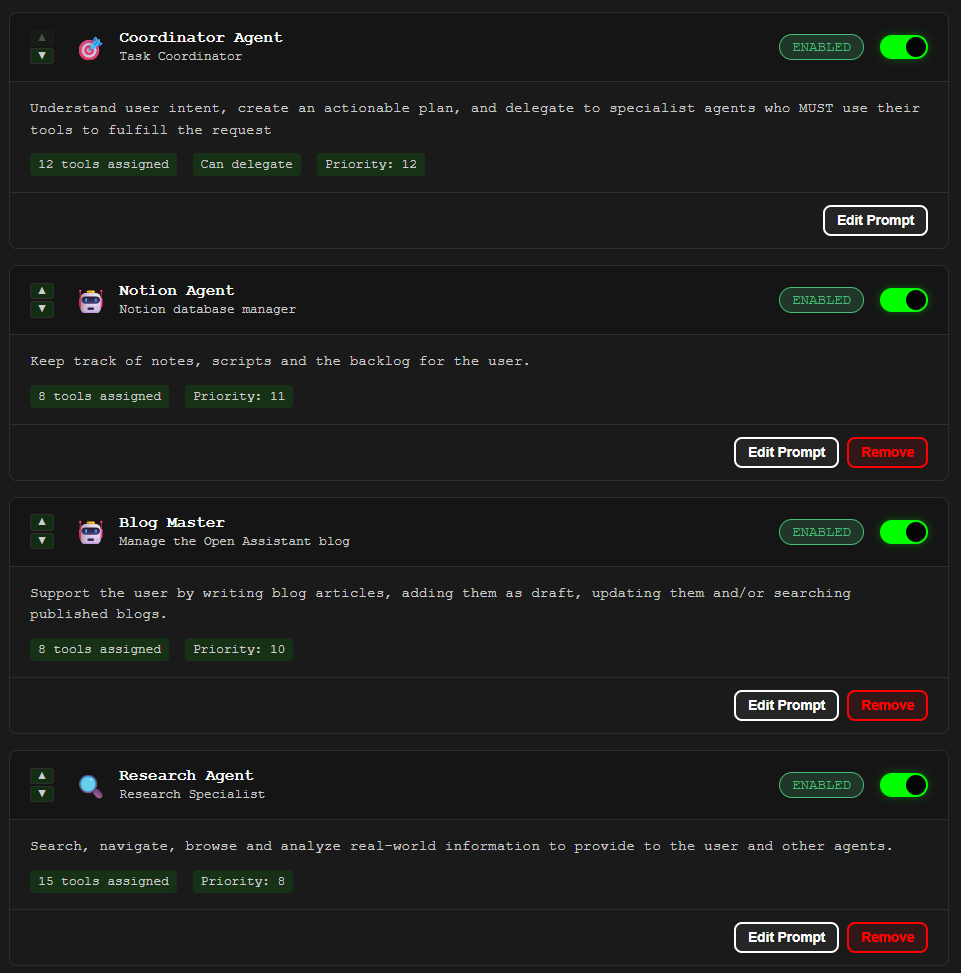
We resolved this by establishing a strict, four-tier multi-agent hierarchy:
- The Coordinator: The central dispatcher that assesses incoming requests, routes tasks, and manages overall workflow state.
- The Notion Agent: A dedicated database specialist optimized solely for querying, updating, and maintaining the central backlog.
- The Blog Master: An agent trained exclusively on editorial style guides, structured formatting, and technical writing standards.
- The Research Agent: A utility agent equipped with web-scraping and document-parsing tools to extract facts and verify technical references.
By enforcing strict tool boundaries — ensuring the Blog Master had no direct database access and the Notion Agent had no writing responsibilities — we minimized cognitive load. Crucially, we separated the agent's core identity ("soul") from its transient operational instructions, ensuring that behavioral guidelines remained pristine and unaffected by changing task requirements.
The key lesson: narrow agents consistently outperform broad agents. An agent with three tools and a single, clear objective will outperform an agent with ten tools and a multi-step mandate. Reducing the branching factor of tool selection is the most effective way to stabilize autonomous workflows.
Diary #5: Dynamic Plugin Creation and Social Automation
With the core writing engine stabilized, we focused on distribution. This phase introduced the Plugin Creator Agent, an advanced utility designed to write its own integrations.
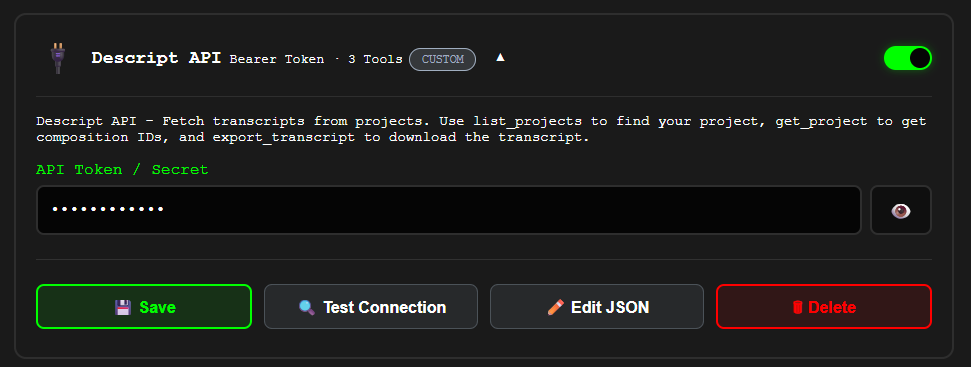
By feeding raw API documentation from services like Descript and Postbridge into the Plugin Creator, the system autonomously generated valid, working integration schemas. The Descript plugin was trimmed to expose only three essential endpoints (list projects, get project, export transcript), and a dedicated Descript Agent was created with explicit intent keywords to handle routing. The Postbridge plugin, exposing 13 social media endpoints, was bound to its own dedicated agent configured for multi-platform publishing across LinkedIn, X, and YouTube.
Critically, API credentials were never passed through the chat interface. The Plugin Creator generated structural JSON manifests without authentication tokens; the operator then entered secrets directly into the encrypted settings vault. At runtime, the assistant securely injects credentials into HTTP headers, keeping sensitive data isolated from chat logs and model provider caches.
The combination of custom plugins, specialized agents, and automated distribution channels formed a complete Content Amplification Loop: a single idea (the diary entry) becomes a YouTube video, which becomes a blog post, which becomes a multi-platform social campaign. Human effort concentrated at the ideation stage; everything downstream — transcription, technical writing, platform optimization, scheduling — handled by the AI system.
Diary #6: Autonomous Automation Flows
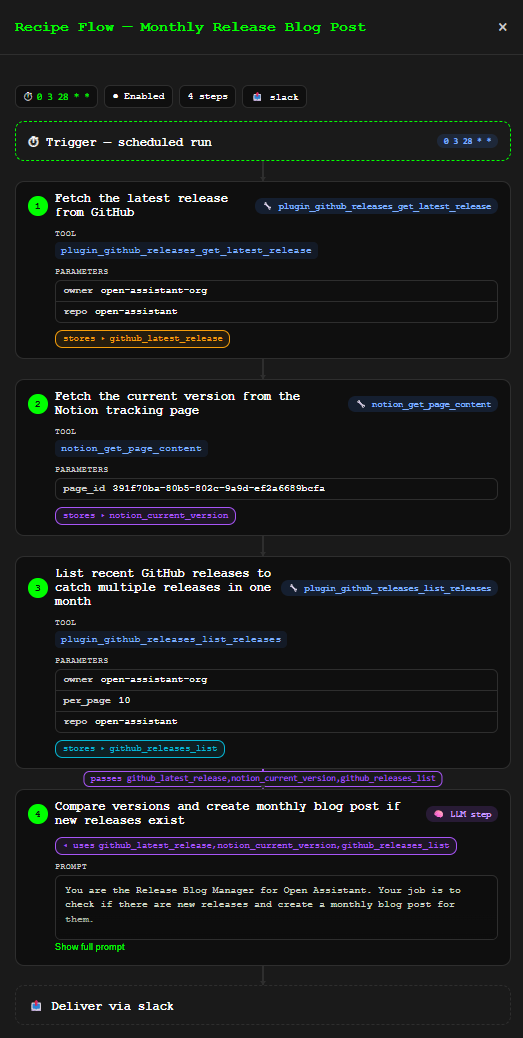
The final phase transitioned the system from reactive execution to proactive autonomy. We implemented three cron-based, scheduled automation flows:
- The Monthly SEO and Content Gap Review: A scheduled audit that crawls live properties, compares them against target keywords, and appends new content ideas to the Notion backlog.
- The Bi-Weekly Blog Draft Engine: A scheduled trigger (Tuesdays and Thursdays at 6:00 AM) that scans the backlog for topics marked
[TOWRITE], gathers background research, and generates complete first drafts — limited to one entry per run to preserve context window fidelity. - The Social Amplification Pipeline: An automated check that identifies newly published posts and schedules distribution sequences across social channels, queued as pending drafts for human approval.
These flows utilized self-discovering tool calls, allowing the assistant to dynamically determine the optimal sequence of API calls based on the real-time state of the backlog. Crucially, we embedded human-in-the-loop (HITL) safeguards: the system prepares drafts and schedules social posts, but no external publish call executes without a physical click from a human administrator.
The system is now running on autopilot. The blog has become a living resource — continuously updated with fresh, technically accurate, and deeply researched content written, optimized, and prepared for distribution by Open Assistant itself.
3. Three Engineering Insights
Building and running this pipeline yielded several counter-intuitive lessons about agentic system design:
Insight 1: Narrow Agents Outperform Broad Agents
A single agent with ten tools will consistently underperform three distinct agents with two tools each. When an LLM is presented with a large toolset, the probability of selecting the wrong tool or formatting arguments incorrectly increases exponentially. Restricting agent scope is the single most effective way to improve deterministic execution.
Insight 2: Do Not Automate on a Shifting Foundation
Attempting to write autonomous loops before your manual integrations, database schemas, and API connections are thoroughly stabilized is a recipe for failure. If a human cannot execute the process step-by-step using the exact same APIs with 100% predictability, an AI agent will not magically solve the instability. Stabilize your architecture first. Automate second.
Insight 3: Human-AI Co-Shaping
System design is an iterative dialogue. As the assistant operated, we observed where it struggled with style transitions or tool calls. Rather than continuously rewriting code, we updated centralized documentation and Notion templates. The system adapted to our feedback, and we adapted our processes to match its structural strengths. This is not one-way programming — it is co-creation.
4. The Broader Mission: No-Code AI Transformation
The most significant aspect of this entire experiment is how it was constructed. Every database connection, agent hierarchy, plugin integration, and scheduled workflow demonstrated across this series was built above-the-line.
No custom Python scripts deployed to serverless environments. No complex infrastructure pipelines maintained by hand. Just structured configuration, clean data schemas, and well-defined agent boundaries.
Open Assistant was engineered to democratize advanced AI operations for non-coding people. By providing a clean, visual, and configuration-driven platform, operations managers, marketing directors, and business analysts can design, deploy, and monitor sophisticated multi-agent systems without writing a single line of code. The content marketing track demonstrated in this series works just as well for personal branding as it does for corporate communications — whether you are a freelancer or running an enterprise.
5. Looking Forward: Expanding the Horizon
The content marketing pipeline documented in this series is merely a proof of concept. The underlying architecture — combining shared operational memory, multi-agent specialization, dynamic plugin generation, and scheduled automation — is highly domain-agnostic.
The same framework is already being deployed across diverse operational landscapes:
- Administrative Operations: Automating invoice reconciliation, cross-referencing expense reports against corporate policies, and flagging anomalies.
- HR & Timekeeping: Auditing timesheet submissions, checking calendar invites, and flagging discrepancies directly to relevant teams.
- Mailbox Automation: Classifying incoming inquiries, retrieving relevant documentation, drafting precise responses, and escalating high-value issues to human teams.
This diary series marks the end of our content marketing deep-dive, but it is only the beginning of the exploration into autonomous business operations. If you have ideas for what you would like to see next — get in touch.